
Your First Fly Rod
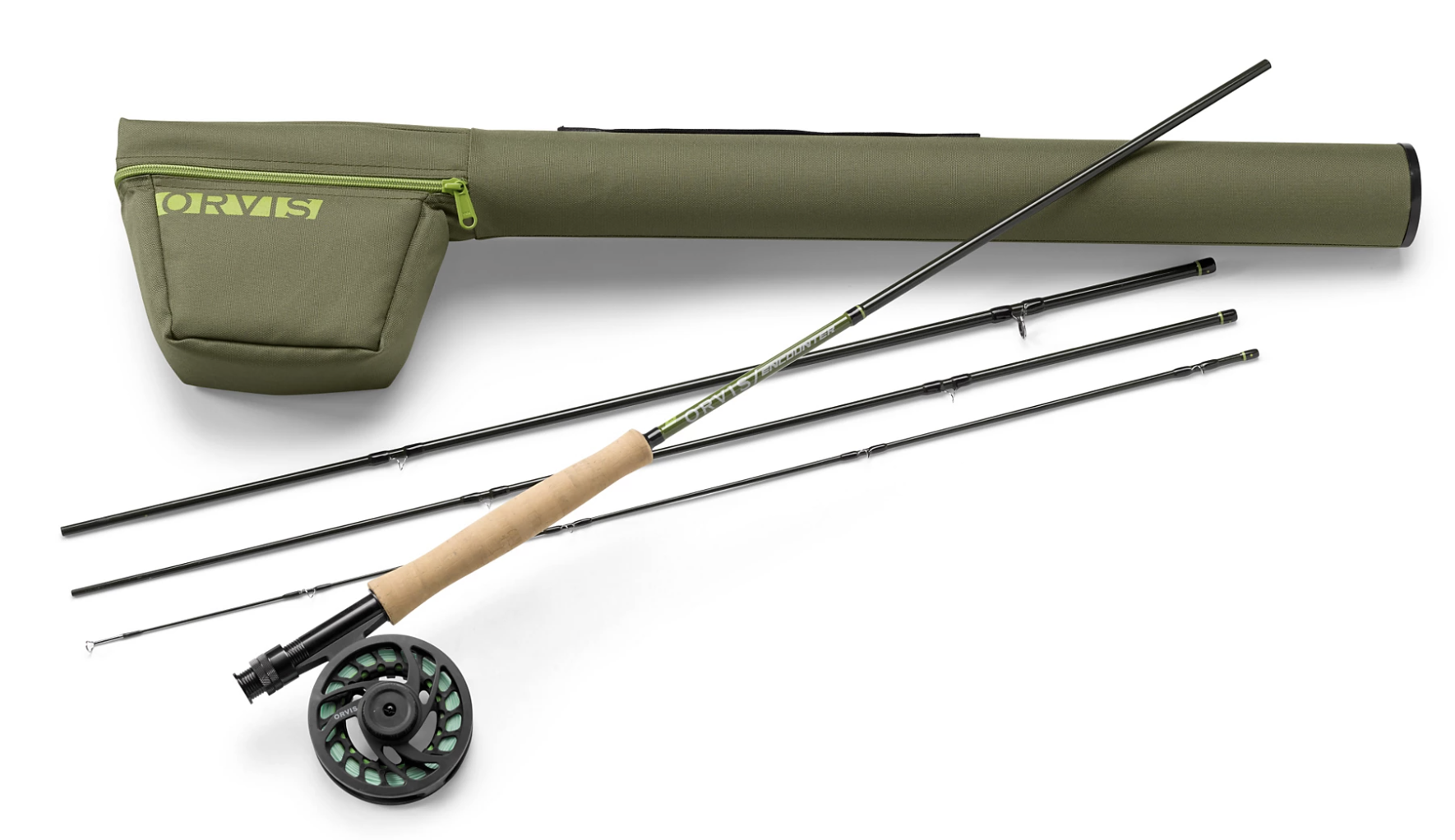
So you've decided to try fly fishing. Maybe you watched someone cast and it looked like something worth learning. Maybe you want to fish the Connecticut River for bass, someone told you a fly rod was a goofy way to do it, and you want to prove them wrong. Either way, you're standing in front of a rack of rods and the labels aren't making much sense yet.
Here's what they mean.
The Rod
Weight: Start Here
Fly rods are categorized by weight, written as a number followed by "wt" — as in 5-weight or 8-weight. This is the most important specification on the rod, and it's the first thing to get right.
Weight describes how powerful and capable the rod is. Low numbers are light and delicate; high numbers are heavy and strong. The scale runs from 1 (tiny streams, tiny fish) all the way up to 14 (saltwater, very large fish). For freshwater fishing in Vermont, you'll live somewhere in the middle of that range.
Think of it this way: you wouldn't use a sledgehammer to hang a picture frame, and you wouldn't use a tack hammer to drive a fence post. Rod weight works the same way. The wrong weight doesn't mean you can't fish — it means everything is harder than it should be.
For most beginners, a 5-weight or 6-weight rod is the right starting point. A 5-weight is the classic trout rod — appropriate for the Battenkill, for dry flies and nymphs, for fish in the 8- to 16-inch range. A 6-weight steps up in power and handles bigger flies, more wind, and the smallmouth bass on the Connecticut River that will absolutely test you once you hook one. If you're not sure which direction you're headed, a 6-weight is the more versatile choice in this region.
Once you've been fishing a season, you'll have a much clearer sense of whether you want to go lighter for trout or heavier for pike and carp. That's the right time to add a second rod.
Length
Most fly rods are 9 feet long, and that's not an accident — it's a length that works well across a wide range of situations. It gives you enough reach to keep line off the water, enough leverage to mend a drift, and enough casting arc to generate reasonable distance without much effort.
You'll see rods shorter and longer than 9 feet, and they have their purposes. But for a first rod, 9 feet is the right call. Don't overthink it.
Action
Action describes where the rod bends when it's under load — meaning when you're casting or fighting a fish.
A fast-action rod bends mostly near the tip. It's crisp, powerful, and good for casting at distance or punching a fly into the wind. Most modern fly rods are fast action.
A medium-action rod bends deeper into the middle of the blank. It's more forgiving for beginners because it's less sensitive to timing errors in the cast. It also protects light fishing line by flexing when a fish runs hard, rather than transmitting that force straight to the tippet.
A slow-action rod bends throughout its entire length. These are uncommon and fairly specialized — beautiful to cast at short range, but not what most people need starting out.
For a first rod, medium-fast action is the most practical choice. It's forgiving enough to help you build a decent cast, but capable enough that you won't outgrow it quickly.
The Reel
Here's something that surprises a lot of new fly anglers: the reel is, in most freshwater situations, the simplest part of the equation. Unlike spin fishing, where the reel does a lot of active mechanical work, a fly reel's primary job is to store your line and provide some resistance — called drag — when a fish runs.
That said, it's worth understanding what you're looking at.
Arbor Size
Modern fly reels are described as large arbor or mid arbor, referring to the size of the central spool core.
A large arbor reel retrieves line faster with each turn of the handle, because the spool circumference is bigger. It also tends to store line in larger, looser coils, which means less memory and fewer tangles. Large arbor reels are the standard now, and for good reason. Unless someone is specifically recommending otherwise, go with large arbor.
Drag
The drag system is what creates controlled resistance when a fish pulls line off the reel. It keeps the line from peeling off in an uncontrolled tangle and allows you to tire a fish without snapping your tippet.
For most trout and bass fishing in Vermont, drag requirements are modest. A basic disc drag system — essentially a friction pad that can be tightened or loosened with a dial — is perfectly adequate. The dial is usually on the back of the reel; turning it clockwise increases resistance, counterclockwise decreases it.
Where drag quality starts to matter more is with larger, faster species. A big carp or a pike running hard across a river flat will test a cheap drag. For beginners, this is a bridge you'll cross later — but it's worth knowing the concept now.
Weight and Balance
A reel should balance the rod it's paired with. Too heavy and the whole outfit feels tip-light; too light and it feels front-heavy. Manufacturers make this straightforward by listing which rod weights each reel is designed to match. A reel labeled 5/6 is designed for 5- and 6-weight rods. A reel labeled 7/8 pairs with heavier setups. Follow that guidance and you'll be fine.
The Arbor Knot and Loading the Reel
When you buy a reel, it comes empty. Before you can fish, it needs to be loaded — meaning backing, fly line, and leader need to be attached and wound onto it in the right order.
Most fly shops will load a reel for you when you buy a line from them, and it's worth taking them up on that the first time. Watching it done once makes it easy to do yourself going forward.
The order of components, from reel outward, is always: backing → fly line → leader → tippet → fly. Each has a purpose, and understanding why they're there helps demystify the whole system.
Backing is thin, strong braided line that fills the reel before the fly line goes on. It gives a big fish somewhere to run without emptying the reel, and it prevents the fly line from being wound in tight coils on a bare, small spool.
Fly line is the thick, coated line that provides the weight to make casting possible. Unlike spin fishing, where the lure's weight loads the rod, in fly fishing the line itself is what loads the rod. This is the fundamental mechanical difference between the two styles.
Leader is a tapered length of clear monofilament that transitions the thick fly line down to an invisible connection at the fly. It's usually 7.5 to 9 feet long for general trout and bass fishing.
Tippet is the finest section at the end — the last foot or two before the fly. It's replaceable, which is important because you'll cut it back every time you change flies.
Putting It Together
If someone told you fly fishing requires a lot of expensive gear and years of practice before you catch anything — that's not the experience we're trying to deliver here. The Connecticut River has smallmouth bass that will eat a well-presented fly on the surface. Ponds throughout Windham County have bluegill that will hit a small popper near a dock in July and make a beginner feel like they know exactly what they're doing.
The gear matters, but it doesn't have to be complicated. A 9-foot, 6-weight rod with a medium-fast action, matched to a large-arbor reel with a disc drag — that outfit will take you a long way. Come in and we'll help you figure out the rest.